Mainstream Adoption, Automated Admin, and a New Federal Office: What These Stories Tell Us About Health Tech's Trajectory
These stories reveal three signals that digital health is shifting from early adoption to infrastructure: wearables have crossed into majority ownership, venture capital is flowing into AI that removes the administrative friction clinicians face every day, and the federal government is formalizing its own digital health leadership.
Here’s what we covered in this edition of The Anti-Newsletter.
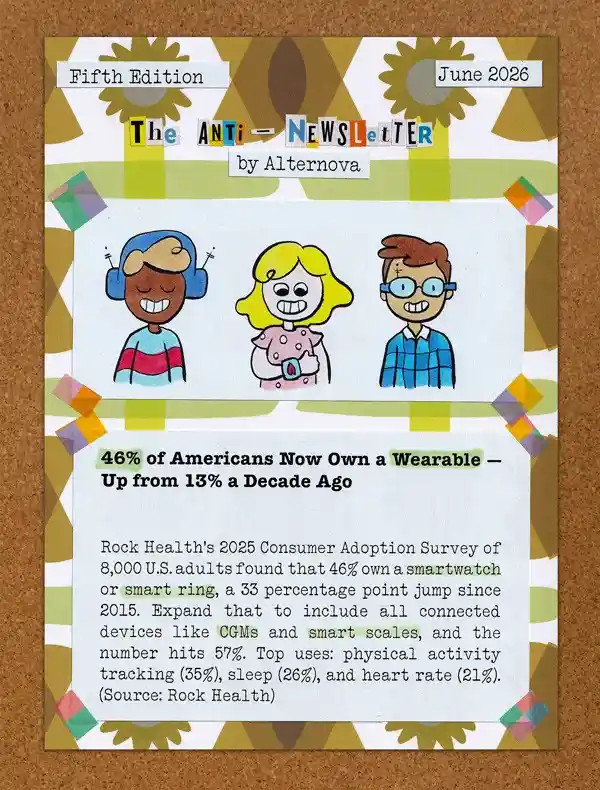
Wearables Cross the Majority Threshold: 46% of Americans Now Own One
Rock Health’s Consumer Adoption Survey of 8,000 U.S. adults found that 46% now own a smartwatch or smart ring, a 33 percentage point jump from the 13% who owned one a decade ago. Widen the lens to include connected devices like continuous glucose monitors and smart scales, and adoption climbs to 57%. The leading use cases remain practical rather than exotic: physical activity tracking (35%), sleep (26%), and heart rate monitoring (21%).
This is no longer a story about early adopters strapping on a fitness tracker. Wearables have quietly become a default layer of personal health infrastructure, generating a continuous stream of biometric data that consumers now expect their care teams, insurers, and health apps to put to use. For health tech builders, the opportunity, and the pressure, has shifted from convincing people to wear a device to designing products that can responsibly ingest, interpret, and act on the data those devices already produce.
The wearable is no longer the product. It’s the entry point.
a16z Bets $30M on AI That Answers the Phone for Doctors
Prosper AI raised a $30 million Series A led by Andreessen Horowitz. The New York startup’s voice agents handle scheduling, insurance verification, billing, and prior authorization, including calling payers directly when electronic checks stall. Since its seed round, revenue has grown 5x, and the platform now covers more than 150,000 providers.
The bet reflects where investors increasingly see leverage in health tech: not in new clinical capabilities, but in erasing the phone tag, hold music, and paperwork that eat up staff time on both sides of every visit. Voice AI that can hold a real conversation with a payer or a patient, not just route a call, turns one of healthcare’s most manual workflows into something that scales without adding headcount.
The most investable health tech right now sits at the intersection of AI and operational pain points.

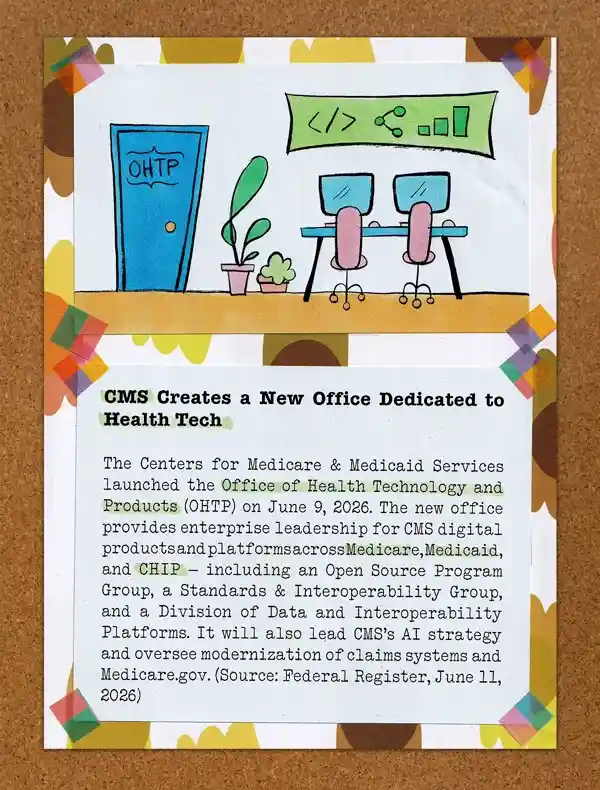
CMS Creates a New Office Dedicated to Health Tech
The Centers for Medicare & Medicaid Services (CMS) recently launched the Office of Health Technology and Products (OHTP), a new body providing enterprise leadership for CMS’s digital products and platforms across Medicare, Medicaid, and CHIP. The office folds in an Open Source Program Group, a Standards & Interoperability Group, and a Division of Data and Interoperability Platforms, and it will lead CMS’s AI strategy while overseeing modernization of claims systems and Medicare.gov.
Standing up a permanent office, rather than a task force or pilot program, signals that CMS views digital modernization as core infrastructure, not an experiment. For founders building anything that touches Medicare or Medicaid claims, eligibility, or data exchange, OHTP is now the address where the interoperability and AI standards shaping your roadmap will be written.
When the payer builds its own tech office, product roadmaps everywhere else start bending toward its standards.
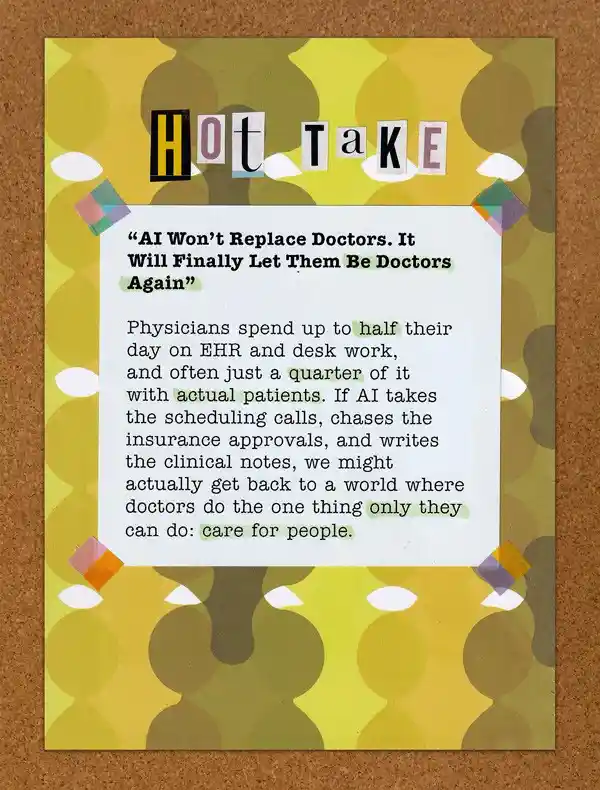
Hot Take: AI Won't Replace Doctors. It Will Finally Let Them Be Doctors Again
Physicians spend up to half their day on EHR entry and desk work, and often just a quarter of it with actual patients. If AI takes the scheduling calls, chases the insurance approvals, and drafts the clinical notes, as this month’s stories on Prosper AI and CMS’s new office both point toward, we might actually get back to a world where doctors do the one thing only they can do: care for people.
The Common Thread
Taken together, these stories describe a health tech landscape maturing on three fronts at once: consumer trust (wearables), enterprise automation (AI voice agents), and public infrastructure (CMS). In each case, technology is being asked to remove friction rather than add complexity. The companies that win will be the ones building for that reality, not around it.