Faster Approvals, Federal Seed Money, and a $7 Billion Wager on Healthcare’s Back Office
May 2026 delivered three stories that, taken together, describe the plumbing being rebuilt underneath health tech: regulators are compressing the path from approval to payment, the federal government is seeding early-stage builders with non-dilutive money, and private capital is concentrating around the unglamorous work of running a hospital. The frontier is not only about what a device can do; it’s about how quickly it can reach a patient and get paid for.
Here’s what we covered in the fourth edition of The Anti-Newsletter (our monthly, hand-cut, no-algorithm health tech scrapbook), and why each story matters.
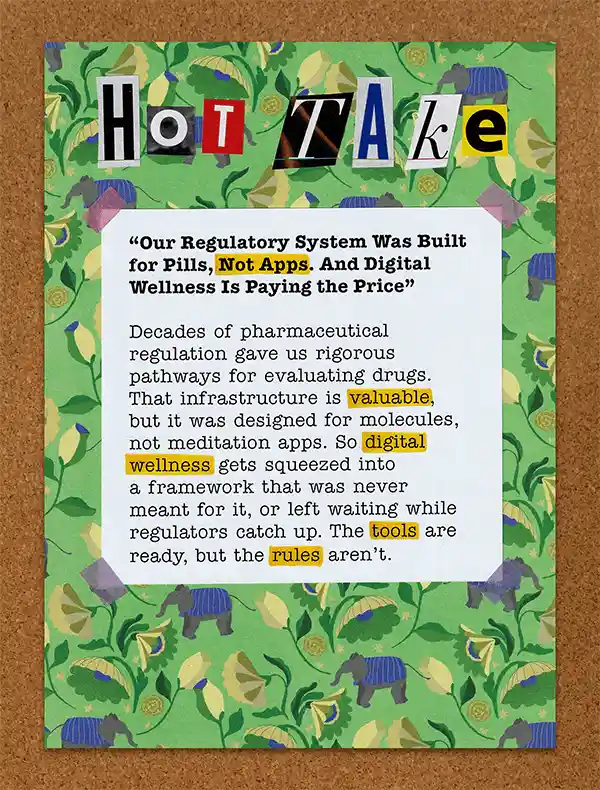
CMS and the FDA Launch the RAPID Pathway to Speed Up Device Coverage
The FDA and CMS jointly announced the RAPID coverage pathway, designed to cut the time between FDA device authorization and Medicare coverage from roughly one year to as little as two months. The initiative aligns both agencies’ review processes early in product development, so the evidence a company collects for FDA approval can directly support Medicare coverage decisions. It applies to certain Class II and Class III breakthrough medical devices.
Why it matters: for most device makers, FDA clearance was never the finish line; reimbursement was. A cleared device that Medicare won’t cover generates little revenue, and the historical year-long gap between the two has sunk promising products and stretched runways past the breaking point. Collapsing that gap to two months reshapes the financial model for hardware-driven health tech, shortens the capital a company needs to survive to first revenue, and rewards teams that design their pivotal trials with payer evidence in mind from day one rather than treating coverage as a problem for later.
ARPA-H Awards $28M to 15 Health Tech Small Businesses
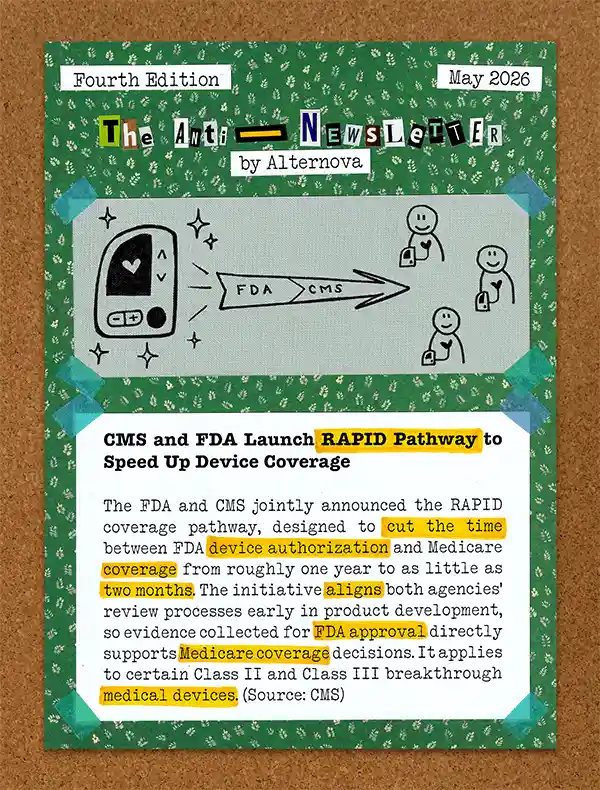
The Advanced Research Projects Agency for Health announced up to $28 million in contract awards to 15 small businesses across eight U.S. states, funding projects spanning wearables, AI diagnostics, gene therapies, brain health, and nutrition tools. ARPA-H described the awards as “seeds for market-ready work,” capital designed to move health technologies toward rapid commercialization rather than open-ended academic study.
Why it matters: ARPA-H is deliberately modeled on DARPA: outcome-driven, milestone-based, and obsessed with getting things out of the lab and into use. For founders, that translates into two things. First, it is a rare source of non-dilutive capital for the riskiest, earliest stage of building, when equity is most expensive to give away. Second, the list of funded categories is a map of where the federal government believes the frontier sits, a useful signal for anyone deciding which problems will attract follow-on public and private money over the next few years.
Healthcare AI Platform Commure Raises $70M at a $7B Valuation
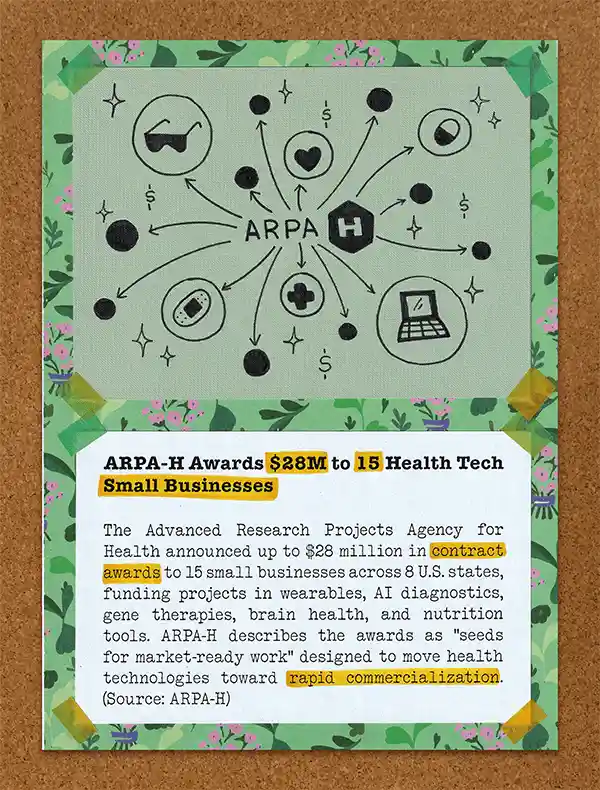
Commure, an AI platform that automates healthcare administration, closed a $70 million funding round led by General Catalyst, with Sequoia Capital and Morgan Stanley joining. Its tools are already deployed across more than 130 major health systems, including Tenet and HCA Healthcare, and target the roughly $1 trillion in annual administrative costs that weigh on U.S. healthcare. The new capital will scale its revenue cycle management and agentic AI infrastructure globally.
Why it matters: the money is flowing to the back office, not the bedside, and that is exactly the point. Administrative overhead is the largest, most stubborn cost center in American healthcare, and it is precisely the kind of repetitive, rules-heavy work that agentic AI can absorb. Commure’s round echoes a pattern we have tracked across earlier editions: the most investable opportunities sit where AI meets operational pain, not where it makes the flashiest clinical demo. A $7 billion valuation built on automating paperwork is a clear statement about where investors think the durable margins in health tech actually are.
Hot Take: “Our Regulatory System Was Built for Pills, Not Apps, and Digital Wellness Is Paying the Price”
Decades of pharmaceutical regulation gave us rigorous, well-worn pathways for evaluating drugs. That infrastructure is genuinely valuable, but it was designed for molecules with measurable pharmacokinetics, not for meditation apps, behavior-change programs, and software that nudges rather than doses. So digital wellness keeps getting squeezed into a framework that was never built for it, or left waiting on the sidelines while regulators catch up. The tools are ready; the rules aren’t.
And here is the tension worth sitting with: the very same month proved that regulators can move fast when they decide to. The RAPID pathway compressed device coverage from a year to two months. The question is whether that same urgency will be applied to building a purpose-built lane for digital health software. Until it is, founders face a bad choice: stay in the “wellness” gray zone to avoid full device classification, which caps the clinical claims they can make and the trust they can earn, or wait in regulatory limbo while the market moves on. Neither serves patients. The opportunity, for regulators and builders alike, is to design evaluation that fits software as it actually behaves, not as a pill in disguise.